
Stop Using Poisons For Heartworm Prevention
Fear Sells (Cost: Your Dog’s Health)
Stop Killing Your Pet: The Top 5 Ways – Part 4
Heartworms. Worms that live in the heart of my dog??? Eeek! Gross!
The very thought of worms living in your dog’s heart (and now, even your cat’s) likely sends a shiver through you
.
To play that feeling for profit, clever marketers who sell heartworm drugs will often feature, prominently in their ads, a picture of a dog’s heart, opened for all the world to see, and stuffed full of long, spaghetti-like worms.
Nothing sells like that. Shiny new cars, snappy boutique clothing, and slick new i-devices take back seat to a fear-inspiring graphic like this.
Out of fear, most pet owners sign up for the monthly heartworm preventative and don’t ask questions.
“I never want those nasty things in my dog’s heart!”
But, you’re here because you’re more thoughtful than that. Good thing for your dog you are.
An Unexamined Drug (Not Worth Giving)
Often forgotten in the rush to prevent these nasty looking heartworms from gaining entrance to your dog’s heart, is what the drug itself can do to your dog’s health.
Once more, we are in the land of pesticides here. With all the attendant risks these compounds carry, including sickness and early death.
Let’s be honest. The drug kills larvae. In all the market double speak about “interrupting the life cycle,” the monthly heartworm “preventatives” just kill the heartworm’s larvae.
The killing field is your dog’s blood. That’s where the larvae get to from the mosquito bite delivery system.
Killing = Toxic
Killing something always comes with a risk.
The risk of “collateral damage.”
–Will innocent people, who have no political agenda, be killed by dropping this bomb on the enemy?
–Will my liver be damaged and my life be in ruins when I sign up for chemotherapy to kill these cancer cells?
–Will my dog’s life be damaged in some way or shortened by killing heartworm larvae?
Useful questions all.
Ivermectin, the chief ingredient of Heartguard, and its cousins in the same class, are indeed toxic. In small quantities. The cousins are in Interceptor, Trifexis, Sentinel, Revolution, Advantage Multi and ProHeart 6.
Has anyone studied them for safety over a period of a dog’s life? You can bet not. They went to market with weeks of study, not even years.
And I can tell you, from experience in my own body, that ivermectin made me ill every time I used it, very cautiously, to deworm horses. Rubber gloves on before use, hands washed afterwards, driving to the next farm, I’d feel dizzy and nauseous.
How much could I have been exposed to? Mere molecules.
ProHeart 6 was recalled in 2004 after the FDA received more than 5000 reports of sick or dying dogs. It’s back on the market.

Buyer Beware!
Resistance. Again.
And, as in all pesticides, resistance builds. Yes, though the manufacturers really, really don’t want you to know this, their drugs are just plain failing to protect like they used to.
In my practice, I have a client in Louisiana whose neighbor’s dogs, while fully on recommended doses of heartworm preventatives, contracted the heartworm parasites. And she’s not an isolated case, as the link above hints at.
Side Effects: May Include Death
Autoimmune Disease: Sound the Alarm!
Much more serious is that these drugs are a common cause of autoimmune disease in the dogs who take them.
A review of 55 cases of autoimmune disease in dogs was very revealing in both causes and outcomes.
Precipitating factors or diseases most frequently implicated in secondary immune-mediated thrombocytopenia or hemolytic anemia were: recent vaccination, drug therapy, obstetrical complications, stress, recent viral infection and neoplasia.
Just over half of all dogs survived…
(emphasis mine: our old favorites, implicated in so much illness, vaccination and drugs)
Here’s a product information sheet of an injectable heartworm prevention poison whose stated side effects include autoimmune disease (and seizures, collapse, liver damage, shock, and bloody diarrhea).
Oh oh. This Can’t Be Good
When my professors in vet school told us about autoimmune disease, even though I’d not yet seen it, I instinctively got a sinking feeling.
I felt pretty confident that infectious diseases could be beaten. Broken bones could be mended, bad teeth could be pulled.
But, disease where your dog’s own immune system attacks him? The very system that he depends on to ferret out the bad guys, kill the evil doers, and lay to waste the baddest viruses?
That system, attacking your dog from within?? Damn.
Tough Disease. Poor Answers.
The dogs with autoimmune disease are in big trouble. Life threatening, hand wringing, high tech trouble. Their very red blood cells are getting wiped out, and by their own immune attack!
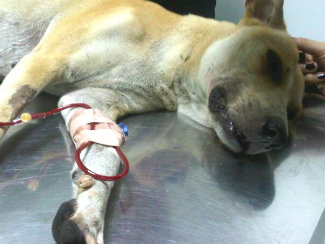 All we had to fight that scary monster always sounded worse to me than the disease: immune suppressors, usually steroids. It was never a clean outcome. Failures abounded, and dogs were dying from this disease.
Blood transfusions sounded lame. “Here, let’s find the safe blood type that won’t set off a rejection reaction by the already confused immune system, and pour that in to your dog’s veins!”
It was just heroics and damage control.
The whole treatment plan left me feeling impotent. I wanted answers to save my patients! Things that worked, by God.
Holistic Medicine, Natural Prevention
I never got those answers from conventional medicine, but luckily, never saw autoimmune disease until I had learned homeopathy, and could treat it effectively.
But we’re talking prevention here. “Stop Killing Your Pet” is the theme of the series, so we need some alternatives to toxic drugs.
And the good news is, that prevention is already built in to your animal. We just have to unlock it, support it, enhance it, and get out of its way.
I found myself lecturing my clients on this so often that I wrote a book and offered that instead. You can very affordably buy my ebook or audio book on my site and read it in the comfort of your easy chair. Or listen on the device of your choice.
The bottom line, which I’ve discovered from working with patients in heartworm endemic areas for the past twenty plus years, is that you don’t need toxic chemicals to have heartworm prevention that works.
You need know how. I share my know how with you in my ebook, based on hundreds of patients who’ve successfully resisted heartworm with my methods. And my many clients who use this program aren’t losing sleep worrying about mosquitoes.
A holistic, “Whole Dog” approach. Prevention that works without poisoning anything or anyone, and keeps the heartworms out of your dog. You can get it here.
[Next up: Give ‘Em Raw Bones!]
[Update: just before going to press with the latest version of my ebook (and the new audiobook version!)
“Vital Animals Don’t Get Heartworms! The Drug-Free Prevention Program That Works,”
I dug into a research paper Dr. Jean Dodds sent me, that directly spoke to the illnesses associated with heartworm pills. Very scary stuff, autoimmune, largely fatal, and clearly coming on shortly after the giving of heartworm pills. The link to the book will show you some examples.
Also, just before the book came out, a patient came to me with IBD (Inflammatory bowel disease, i.e. E.R. type of diarrhea and vomiting), and her owner and I realized it recurred monthly. After her heartworm pill! That case was posted here.]




Our rescued husky-German shepherd was diagnosed with Thrombocytopenia in December 2016. He was also diagnosed positive for heart worm. 9 months of rigorous steroids and antibiotics and he is finally bouncing back. We are almost completely off the steroids. Unfortunately, we still have the heartworm to deal with. The shots the vet is recommending are troublesome.
They are very expensive and I worry that pumping him with even more chemicals will upset the health he has finally regained. Any helpful information would be very appreciated.
Hey Amy,
A good homeopathic vet can cure this, but it’ll take some time. In my patients, the majority have cleared their HW in 6 months.
The other option is an herbal treatment, and you’ll have to Google for that one. I’ve only heard it works but have no experience myself.
Hi there can you recommend a homeopathic? or Anything ? I have read things about Guinness Beer I feel like I am beating my head up against a wall trying to heal my dog I rescued from down south with heartworm without harsh drugs. The herbs were not doing well with him. I know every dog is different and after much trial I had to take him off the herbs 🙁 I would be so appreciative for any help ! I have had multiple consults with not great results. I love this dog so am I am desperate. We are building up his body so much with diet and supplements. Thank you for your time!
Hi Jodi,
The homeopathic treatment I’m speaking of is not a remedy, it’s called constitutional prescribing, and it takes a qualified homeopathic vet to do, one who regularly treats chronic disease. It’s the underlying chronic disease that creates worm susceptibility and when that is cured, the worms will have no home.
I just updated my How to Search Out a Qualified Homeopathic Vet video. If you haven’t worked with someone like this, you’ve not given homeopathy a fair trial.
I use Wondercide products and like them. I live in Texas and to control mosquitoes in backyard I have built tiny caves with rocks, whole building is about 5x 3 ft., and they are heavily populated by frogs. They must be eating something because some of them are the size of small chickens. Lots of birds come in, too.. My girl has daily runs around the yard for about 3 minutes each, chases a few squirrels and then spends most of her time inside. My kitties are inside kitties too. To keep her immune system strong we take kefir and supplements from Dr. Belfield.com. No shedding GSD.
Nice, Cecilia. Sounds like you’ve built a nice natural environment there. No shedding in a long haired commonly shedding breed says you’re doing something right!
Keep up the good work!
Hi, my boxer started having seizures when she was switched from Interceptor to Heartgard. Consequently, I am not giving her heartworm medication or insecticides to ingest anymore. I have just bought organic lemon oil to mix with water to spray on her coat. Hope it keeps the mosquito’s away!!
Hi Donna,
She was “talking” to you pretty loudly about the drugs, wasn’t she? Glad you listened.
I have been researching natural flea killers for my kids and have tried a few. I stuck with one called Evolv from wondercide.com. It works very well for me and i live in Florida where fleas and mosquitoes are plenty. It also repels mosquitoes. They also have a yard spray that i use.
I heartily agree, Barbara. I like their product line, even for indoor use, and would hope more people see this as an effective means of getting off the poisonous pesticides so commonly used.
Thanks for bringing it up. I’ve got this and other natural products mentioned on my Non-Toxic Flea/Tick Control page.
I have an online shopping cart full of the products you mentioned on your flea control page, however…. I can’t find the link(banner) to the nematodes. There are hundreds on domyownpestcontrol. Can’t seem to find ANTidote. Could you please post a link to the product you would use… right now I’m looking at Orcon. Thank you so much
Antidote isn’t online that I’m aware of, but here’s nematodes that are: https://vitalanimal.com/va/diy-nematodes/
Sorry for your trouble.
Thank for this great site. I just found you googling Trifexis, and have signed up for your newsletter.
In the Southeast mosquitoes are always a problem, especially for those of us who like to send a lot of time outdoors. I’m a mosquito magnet unfortunately.
I have found pretty good results for several years now, both for humans and for our miniature short haired dachshund, with “Repel”, a non-pesticide commercial repellent pump spray that I get at Wal-Mart’s camping department. This is the same brand name and manufacturer as the Repel with DEET, but this is completely DEET-free.
Label states the active ingredient is ‘plant-based 30% Oil Of Lemon Eucalyptus”, which the label says in turn is 65% “p-menthane-3.8 diol”. 70% unnamed ‘other’ ingredients. Pleasant smell, washes off with soap and water, and I find it works well to keep mosquitoes from landing (they just circle in frustration, then move on).
For our outside dachshund, I spray the ‘Repel’ onto the cotton bandana around her neck or onto the fabric of her Puppia nylon halter (her ‘sports bra’). I’ll spray it directly on my bare skin, but not on the dog’s skin.
This repellant works well for humans and as far as I can see it works for her as well. I’ve been using it on myself since at least 2007, and our dog joined us in 2010. Never any side effects or skin reactions to humans or dog. I’m aware of the problems with DEET and found this product as a safer alternative.
I’d like to know what you think, Dr. Falconer. So far I’ve been very pleased with the effectiveness and no side effects of the Lemon Eucalyptus ‘Repel’. Is there something I should be aware of, or is this a good product to continue recommending to others?
Hi Andrew, the lemon eucalyptus in itself is a significant repellant, and can be bought in pure form from the vendors of essential oils. I’ve used it on some cattle I was milking, and it helped. I’d be concerned about the 70% “other” ingredient make up, however. Anything could be in there. The “inert” ingredients in Roundup are thought to be some of main problems, and as they are not the “active” ingredient, Monsanto is shielded from revealing them.
I got mine from Frontier Coop out of Iowa, but there are likely many sources of the pure E.O.
I stopped giving this crap over 3 years ago. My dogs are all raw fed and raised with no chemicals. We live in rural South Carolina and our neighbor has a pond. There are a LOT of mosquitoes here. I have my dogs tested for heart worms every 6 months.
They always test negative.
I’ve also read of vets in Europe and Japan successfully using Guinness Stout beer to treat dogs with heartworm. Wish more vets over here were open to non-pharmaceutical solutions.
Hi I just stumbled across this webpage and found it all very interesting and also overwhelming My 2 year old female Siberian husky gets the pro heart vaccination yearly for heart worm shes only been tested once and wondering if i should test her again as shes low energy over weight and tired easily which are a few symptoms of having heartworm-Or just being overweight…. Would it be good to test her just encase she somehow attracted it while on prevention? I also double dosed her with an all-wormer chew once thinking she was over due for her next vaccination and called the vet to check if it was necessary or bad then realized I had given it to her for nothing. I saw there is a book you can purchase on how to prevent heartworm without the chemicals I’m always wanting to try a natural method as I don’t trust anything made in this world. I am also wondering about the chemicals they use in flea/tick treatment.. I never like using it I always feel it may be really harmful there’s something not right about it. what are your thoughts on medications for animals in regard to parasites? Blessings
Hi Chloe,
HW testing should be a yearly event if you live where this parasite lives. I recommend that in my drug free heartworm book that you mentioned. It’s important to realize that the drug given by injection (Pro Heart) was recalled after many dogs died several years ago. It, like the flea drugs is a pesticide. It poisons the larvae, and the hope is not the dog while it’s at it.
Be sure to visit my Non-Toxic Flea Control page. You’ll see how they can be controlled well without risk to pets or people.
Welcome aboard. Take your time, and change one thing at a time. Good start is stopping future vaccines. Then, take pest prevention to a safe level. Then, look at diet improvement.
I purchased your ebook on heartworms several months ago. We have many cats that we “serve” and one canine. The “kids” have been on raw for seven years. The dog, Jethro Bodine has only been a member of our family for nineteen months. We found him extremely malnourished and heartworm positive. Unfortunately, I had not found your website and he was treated for the heartworm in the conventional manner. It was a nightmare watching my boy fighting to get better. The only vaccines that Jethro has received is the rattlesnake vaccine and a rabies vaccine. I do not plan on ever vaccinating him again. The cats are not vaccinated and are indoor only. No one has fleas and we do not use anything for fleas around here. We use nematodes on our lawn. I am rambling, but trying to explain. Jethro had his last Heartgard dose three months ago. And yet I am petrified. I have read about giving black walnut hull to dogs for parasites. Is there something more I can do to protect him? I live in the Fort Worth, Texas area. Should I be spraying a natural mosquito repellant on him when we go outside? If so, what should I use? I only want the best for Jethro and the cats. Here is what we feed the “kids”. For breakfast the kids get chicken legs and turkey legs. For dinner we give a ground mix made from fresh farm eggs, chicken liver, whole ground chicken thighs, chicken hearts, salmon oil and an immune blend supplement. Jethro gets beef brisket bones and beef heart several times each week. Here and there Jethro gets bison. If there is anything I am not doing that I should be doing, please comment. One last question, with the diet that I am feeding, is there any need to give glucosamine, MSM or hyaluronic acid for the older arthritic kids? Thank you for your time.
Hello! I have a little Toy Fox Terrier that is going to be 12 and I took her to have her teeth cleaned. The vet wanted her to have a Rabies Vacc. and I told her no. She does the wellness blood test and returns to tell me that my dog tested positive for Heartworms. I first thought that maybe this was her way of not having to do the dental on the dog. But she called me the next day and told me a lab confirmed the positive result. Which still doesn’t mean it is. So then it was recommended to me by some natural friends that I contact a Dr. Wessner in Florida for his program for treating heartworm and I called him. He called me back left a message and I tried calling him and no return call. He does not have a website and he seems to be really hard to get a hold of. I was just wondering if you were familiar with this vet and what you thought about his program. That is if you were familiar with the program. It can be found on Danebytes.com. It sounds really good to me since it seems gentle and holistic. I do not want my little girl to go through the conventional route using the toxic mix of poisons.
I thought it would be a good idea to get another heartworm test done by another vet just in case?. My little girl doesn’t get any vaccinations,commercial garbage feed ,any pesticides or other toxins.
So could you please give me your thoughts about any of what I have written here. Or do you have any suggestions. Thank you so much for your time. I do appreciate it.
Hi Barbara, welcome.
I am not familiar with Dr. Wessner or his protocol, but if he’s getting success with it and it’s safe and works with the animal’s health as a means of ridding the parasite, it should be fine.
I’ve treated a dozen or so positive dogs over the years with classical homeopathy, largely successfully. The animal gets healthier, and the worms no longer have a home. Nothing to “kill” the worm per se. Not easy, and not “one size fits all,” but it’s worked for me.
Best of luck, and if you venture onto that path, perhaps you’ll report back here and let us know how it worked for you.
Thank you so much for replying to my message Dr. Flaconer. I have started my little one on the program and I will let you know how it works one way or the other. I pray that it does. I don’t know why it wouldn’t . She doesn’t get any commercial food. As much organic as I have the money for but all raw and some cooked foods for dinner. Lots of good organ mix and muscle meat, heart,liver,kidney etc. And a mixture of other meats and bone.Soooooo??????
I am very disappointed that she tested positive in the first place. But then that positive in my mind is still a question till I get her tested again somewhere else just to be sure. She has been on raw or home cooked since she was a puppy . Never has had a rabies vaccination-shhh!. She had the first set of puppy vaccinations as per the breeder/puppy mill owner. Never any of the other ones, no heart worm preventative. So I just don’t understand? But anyway thank you so much for your message. I will let you know how everything comes out.
Barb.
Hi! could you tell me if your book comes in a hard copy to order?
Hi Janet,
It doesn’t. But, as it’s a pdf file, those who like to have a paper copy just fire up their printer, print it out, bind it (Kinko’s, Office Max, etc.) and have a hard copy they can take notes in.
I have been back and forth with the hartguard-plus with my two Morkies-Plus, I live in south Florida-Lots of bugs-I spray a holistic spray on them-but would like some more natural ways to keep them safe. They are due for their dose the first of March-I hate giving it to them!!!!Any advice??? I do use Frontline plus (another poison I have been back and forth with)They picked up ticks and thats when I started them back on Frontline plus. Living in Florida does not help-Please advise-and thanks for your articles-
Joanne Dean
Hi Joanne, and welcome to the discussions.
I’ve lived in mosquito-laden areas for the past 25 years (Hawaii year round, and Texas for most of the year), and my clients in both states who’ve followed my Drug-Free HW Prevention Program have avoided HW in their pets. Avoided it without the risk of the drugs that I point out.
Similarly, fleas and ticks can be a long term nuisance in my area, and the Non-Toxic Flea Control methods have served my patients very well. I explain on this page how to choose products that fit your situation, but more importantly, how to think about the problem so you can focus your efforts where they will have the “biggest bang for the buck.”
I’m sure you’ll find things that work for you in Florida in these pages.
Joanne,
I stopped using all the Frontline crap years ago. I felt like I was just dumping toxics on my dog and slowing killing them. A friend of mine told me that coconut spray works well for keeping the fleas and tics off. I also use garlic in small amounts mixed with their homemade diet along with the coconut spray and haven’t found a flea or tic yet.
Good Luck! I think if you go to http://www.greenpaws.org you will change your mind about using frontline.
i haven’t given any of my 3 dogs and 5 cats anything for heartworm for over 3 years since stopping all meds and going raw. i use a non-toxic parasite powder (buck mountain) and occasional essential oil spray on the dogs when we’re in the woods. i also keep citronella plants around the porches for mosquitoes and will rub my hands on them sometimes and wipe across theircoats .
Hi Will,
I have followed your advice to focus on maintaining a strong immune system and not relie on toxic heartworm pills for our Malti-Poo, Sam-E.
Additionally, as soon as, mosquitoes appear in the spring I turn-on 24/7 a bug zapper in our backyard and spray Sam-E with a homemade dilution of 15 drops each of Lemongrass oil and Cinnamon oil in 16 ounces of water, before each morning walk. I think it helps.
Very Best Regards,
Michael
Howdy Will, just recently signed up for your newsletter. Good job!!
Hey, thanks, Dr B, and welcome aboard. I welcome your input, any time you feel like joining the discussions.